AI Analysis
Raven's AI advisor works with your engagement data. It reasons over the hosts, findings, and notes you've collected and helps you decide what to do next, write findings up, and draft report content. It runs Claude (Anthropic) through your Chamber Door account.
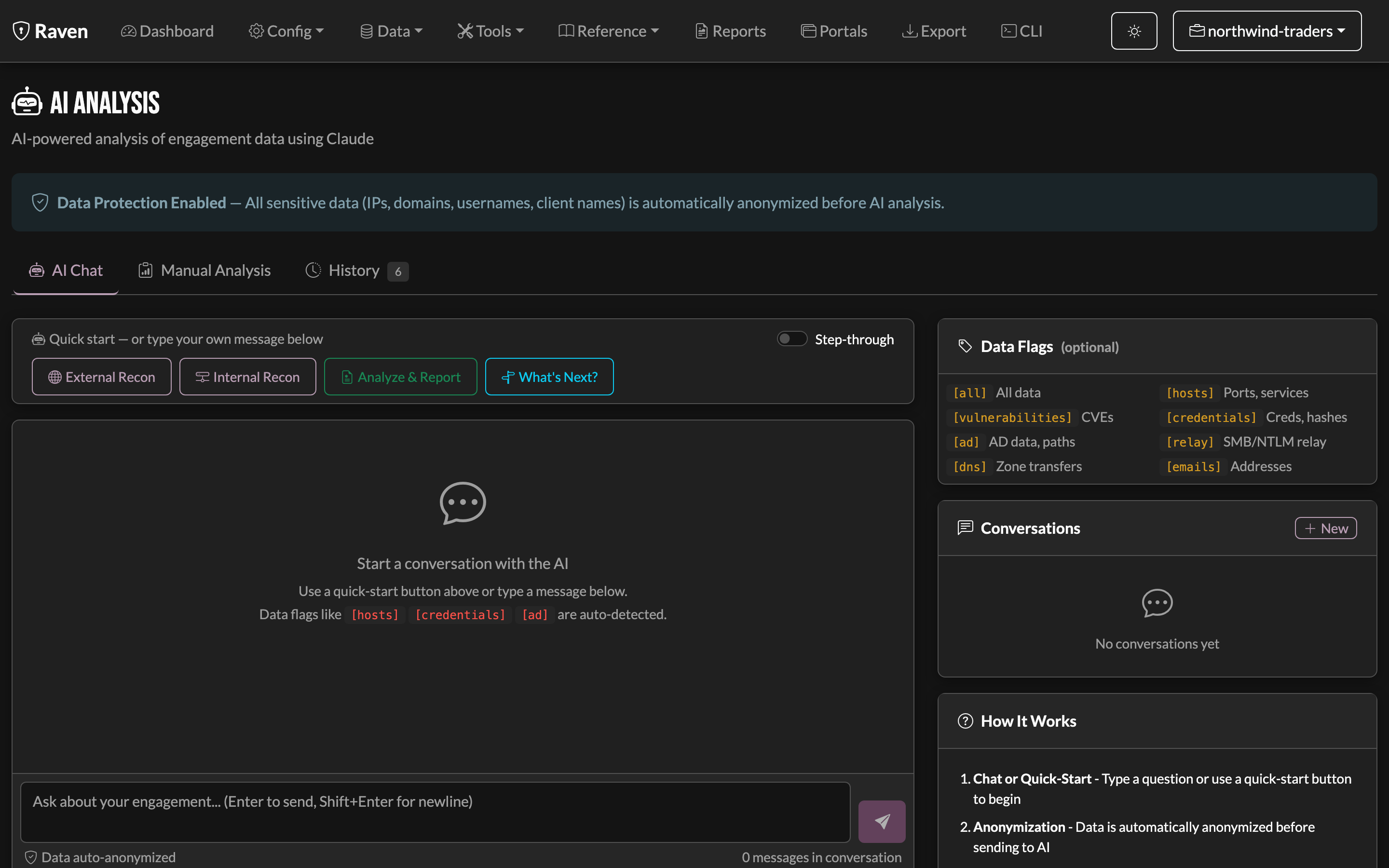
You drive it from the AI Analysis section of the web dashboard, or from the AI commands in the REPL. Both surfaces hit the same proxy and behave identically.
Draws AI credits
AI analysis needs a paired device with available AI credits. The local pentest workflow works without it, including a client deliverable: the basic report renders scope, methodology, host inventory and findings by severity with no AI at all. See also Offline Mode.
How it works
Every AI request follows the same path:
- Anonymized locally. Real IPs, hostnames, domains, emails, and usernames are replaced with placeholders (
host-1,TARGET-IP-1,CLIENT-A, …) on your machine before anything is sent. The mapping table never leaves the binary. - Proxied through Chamber Door. The anonymized context goes to Chamber Door, which renders the pentest methodology server-side, calls Claude, and meters the cost against your AI credit balance.
- Mapped back locally. The response is de-anonymized on your machine so you see your real hosts and names, and is scrubbed for any data the model may have echoed back.
Chamber Door only ever sees anonymized snippets plus account metadata, never raw engagement content.
The advisor and chat
The AI Analysis page is a chat interface backed by the engagement you have open. You can:
- Ask the advisor what to do next. It looks at your current hosts, services, and findings and suggests methodology-grounded next steps.
- Have it run modules for you. The advisor can launch scans and read the results back in a tool-use loop, then reason over what came out.
- Draft findings and report narratives. Turn raw evidence into write-ups, executive summaries, and remediation guidance.
Autopilot vs. step-through
A single chat message usually triggers many Claude calls. It works iteratively, running a module, reading the output, deciding the next move. Two modes control how aggressive that loop is:
- Autopilot lets the advisor iterate freely (run a module, analyze, run the next) until it has an answer. Good for "do a full external recon" where you don't want to babysit each step, but it burns budget faster.
- Step-through holds the advisor back from running modules on its own, so you stay in the loop on each action.
History
Past conversations are saved per engagement and reachable from the History view, so you can revisit an analysis without re-running (and re-paying for) it.
Budget
AI usage is metered server-side against your credit balance. Credits can be bought a la carte and don't expire, or come with a subscription at a better per-credit rate. Because one message is many Claude calls, costs add up per iteration, not per message. A heavy autopilot run is far more expensive than a single focused question.
Your current spend and remaining credits are on the dashboard at app.chamberdoorsecurity.com. To stretch a budget: ask focused questions, prefer step-through for exploratory work, and don't re-run analyses you've already saved.
If you hit the ceiling, AI calls return 402 BUDGET_EXHAUSTED. See Troubleshooting.
Reviewing AI output
Treat AI output as a strong first draft, not a final answer:
- Verify technical claims against your own evidence.
- Confirm any host, CVE, or IP the model mentions actually appears in your data. (Raven marks content it can't trace back to your engagement, but read critically anyway.)
- Adjust tone and specifics before anything reaches a client deliverable.